For project managers and procurement heads specifying large-capacity liquid storage, the choice between an FRP (Fibre-Reinforced Plastic) tank and a Zincalume bolted steel tank is one of the most consequential decisions in the project. The wrong call can mean expensive retrofits, downtime, or compliance failures a few years down the line. The right call delivers two or three decades of reliable service. This guide compares both technologies on the factors that actually matter at procurement time.
What Each Technology Is
An FRP tank is built from fibreglass mat or roving impregnated with polyester or vinyl-ester resin, cured into a composite shell. It is essentially a plastic structure reinforced with glass fibres. Most FRP tanks are produced as one-piece moulded vessels or as panel-bolted variants.
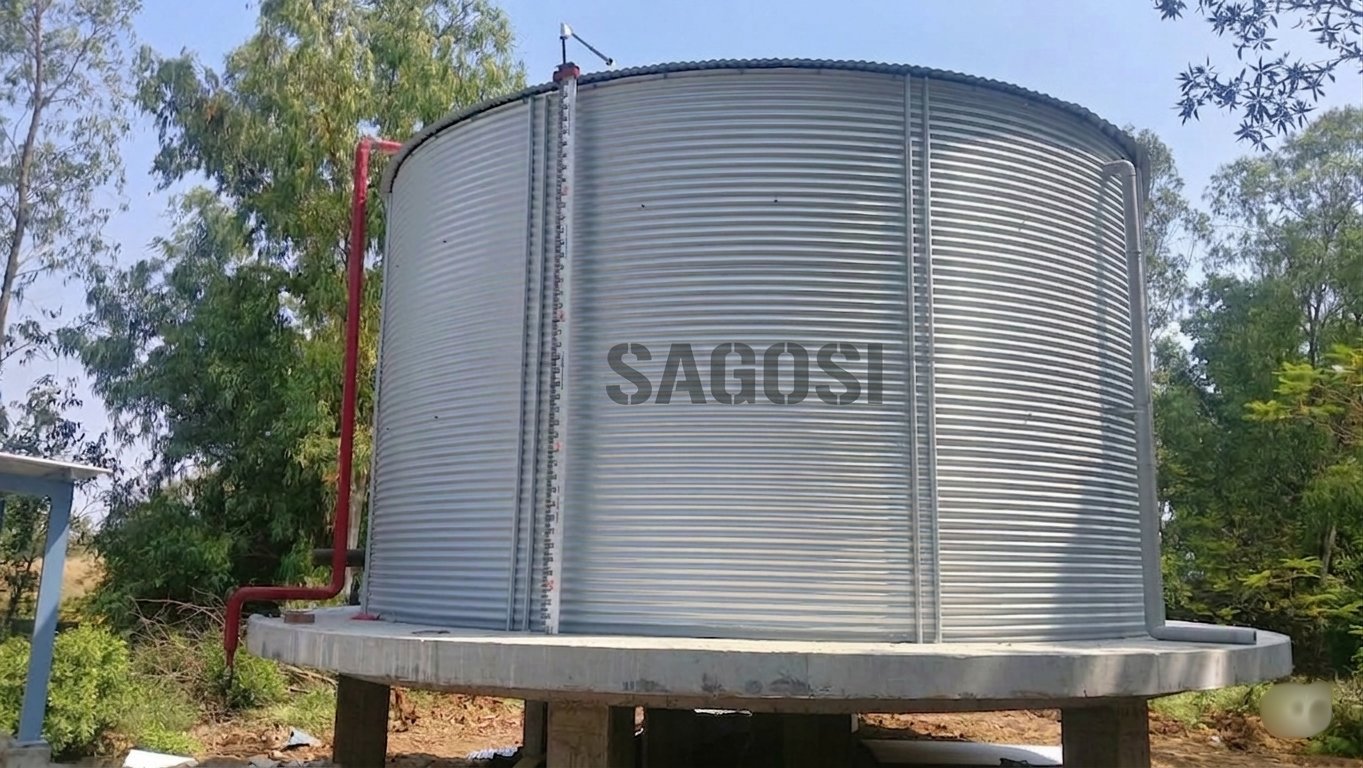
A Zincalume tank uses a steel substrate coated with a zinc-aluminium-magnesium alloy. The alloy delivers metallurgical, self-healing barrier protection — when the surface is scratched during installation, the zinc-aluminium matrix sacrificially oxidises and protects the exposed steel. Zincalume tanks are manufactured as factory-prepared panels that are bolted together on site over a multi-layered reinforced inner liner.
Side-by-Side: The Key Decision Factors
- Structural strength — Zincalume steel offers significantly higher tensile strength and impact resistance. FRP is brittle and prone to cracking under impact or seismic load.
- Corrosion resistance — Both perform well in standard water service. FRP has an edge in highly aggressive chemicals; Zincalume excels in coastal and humid environments with its self-healing metallurgy.
- Service life — Properly specified Zincalume tanks routinely exceed 20–40 years. FRP tanks typically deliver 15–20 years, with resin weathering and joint deterioration becoming issues in the second decade.
- Installation speed — Both are site-assembled. Zincalume bolted tanks of up to 100 KL can be erected in 3–4 days. FRP panel tanks are faster for small sizes but slower for large capacities.
- Standards compliance — Zincalume tanks are designed to Australian Standard AS 2304-2011, ANSI AWWA D103-09, and FM Approval for fire water service. FRP tanks generally lack FM Approval for fire protection use.
- Capacity range — Zincalume tanks scale economically from 10 KL to over 30,000 KL. FRP tanks become disproportionately expensive above ~250 KL.
- Relocatability — Both bolted Zincalume and panel FRP tanks can be dismantled and relocated. Welded steel and one-piece FRP tanks cannot.
- UV and weather resistance — Zincalume is unaffected by UV. FRP resin can weather and chalk over time, sometimes leading to fibre exposure on poorly finished tanks.
Where FRP Wins
FRP is the correct choice when you are storing aggressive chemicals that would attack any metal substrate — concentrated acids, certain solvents, or process chemistries with pH below 3 or above 13 in combination. FRP also has a place where weight is a binding constraint (rooftop tanks, mobile installations) and where capacities are small (under 50 KL).
Where Zincalume Wins
For the bulk of industrial liquid storage — fire water, potable water, raw water, treated effluent, process water — Zincalume bolted steel tanks deliver a better outcome on almost every metric that matters at industrial scale. The combination of high structural strength, self-healing corrosion protection, long service life and proven compliance standards is difficult to beat.
- Fire hydrant water storage — FM Approval is a prerequisite many FRP tanks cannot meet.
- Industrial and municipal water — Zincalume delivers 20+ year service at lower lifecycle cost.
- Large-capacity storage (above 250 KL) — bolted Zincalume scales economically.
- Coastal and humid sites — the Zn-Al-Mg alloy outperforms FRP weatherability long-term.
- High-impact or seismic-prone sites — steel ductility absorbs shock that cracks FRP.
The Lifecycle Cost Reality
It is common to see FRP tanks marketed as a cheaper alternative to steel. This can be true at the line-item purchase price for small capacities — but the comparison reverses sharply when you consider total cost of ownership over a 20-year horizon.
A 500 KL Zincalume tank carries minimal maintenance through its design life. An equivalent FRP tank may require resin-coat refurbishment around the 10-year mark, with the associated downtime and re-commissioning cost. When the cost of unplanned production interruption is added, the lifetime economics frequently favour Zincalume by 30 to 60 per cent.
Compliance and Insurance Considerations
For fire protection water storage, insurers and authorities increasingly require FM Global approval. FM Approval is rare on FRP construction; it is standard on properly specified bolted steel tanks. Specifying a non-FM-approved tank can increase insurance premiums and, in some jurisdictions, void coverage entirely.
How to Decide for Your Project
Run your decision through these four filters in order. If any one of them is inconclusive, request a technical consultation before specifying.
- What are you storing? Aggressive chemicals below pH 3 or above pH 13 → consider FRP. Water, fire water, effluent → Zincalume.
- What capacity do you need? Under 50 KL → either works. Above 250 KL → Zincalume becomes the economical choice.
- Is FM Approval required? Yes → Zincalume is the practical answer.
- What is the project horizon? Under 10 years → either acceptable. 15+ years → Zincalume is the lower-risk choice.
The Bottom Line
FRP has a legitimate place in industrial storage — primarily for small-capacity aggressive chemical service. For the broad use cases of water, fire water, effluent and bulk industrial liquid storage at any meaningful capacity, Zincalume bolted steel tanks deliver superior performance, longer service life, and a lower total cost of ownership.
At SAGOSI we engineer and supply Zincalume bolted steel storage tanks designed to AS 2304-2011 and AS/NZS standards, with engineered service life of 40 years and above. Our team can help you specify the right tank for your project, compare it honestly against alternatives, and deliver it to site on schedule. Get in touch through our enquiry form for a tailored proposal.