If you operate an effluent treatment plant in India, you know the problem already. The civil RCC tank that was built five or seven years ago has started seeping. A line of damp appears at the base. Then a hairline crack. The contractor is called in, a waterproofing job is done, and the plant runs for another year — before the leak comes back, often somewhere new.
We have spoken to dozens of plant operators across India over the past few years who tell us the same story. Continuous waterproofing has become a recurring line in their maintenance budget. The civil tank itself is not the failure point of a single event — it is failing slowly, continuously, by design. This article explains why, and what we recommend customers do instead.
Why Civil ETP Tanks Leak — The Real Engineering Reasons
A reinforced concrete (RCC) tank for effluent service is fighting four problems at once. Understanding these explains why no amount of waterproofing solves the underlying issue.
- Concrete is porous by nature. Even high-grade M30 concrete has a permeability of around 10⁻¹² m/s — meaning effluent will slowly migrate through the matrix unless an impermeable barrier blocks it. Coatings degrade. The matrix does not.
- Effluent attacks concrete chemically. Sulphates, low pH and ammonia in industrial effluent react with the calcium silicate hydrates in cement, weakening the matrix from the inside. This happens whether or not you can see it.
- Reinforcement corrodes inside the wall. Once moisture reaches the rebar, it rusts. Rust expands to about 6 times the volume of the original steel, splitting the concrete from within. This is why cracks appear suddenly years after construction.
- Joints, construction discontinuities and pipe penetrations are inherent weak points. Every cold joint, every nozzle, every shutter mark is a potential leak path. RCC tanks cannot be made truly monolithic at industrial scale.
Why Repeated Waterproofing Keeps Failing
When the tank starts to leak, the standard response is to apply waterproofing — crystalline coatings, epoxy paints, cementitious renders, or membrane systems. These do work, briefly. The problem is that they treat the symptom and not the cause.
A waterproof coating is only as durable as its weakest point — which, in an active ETP tank, is everywhere. The substrate is still concrete that is still being attacked chemically. Thermal cycling, biological activity at the wall, mechanical stress from sludge handling, and occasional impact during cleaning all break the coating in unpredictable places. Most epoxy and crystalline coatings deliver 18 to 30 months of service in aggressive effluent before they need re-application.
Over a 20-year plant life, an operator can easily spend 1.5 to 2 times the original tank cost on repeat waterproofing — not counting the downtime each application requires. Each shutdown means the treatment process stops, effluent has to be managed elsewhere, and compliance with discharge norms gets tight.
The Real Solution: Micro-Coated Steel Tanks
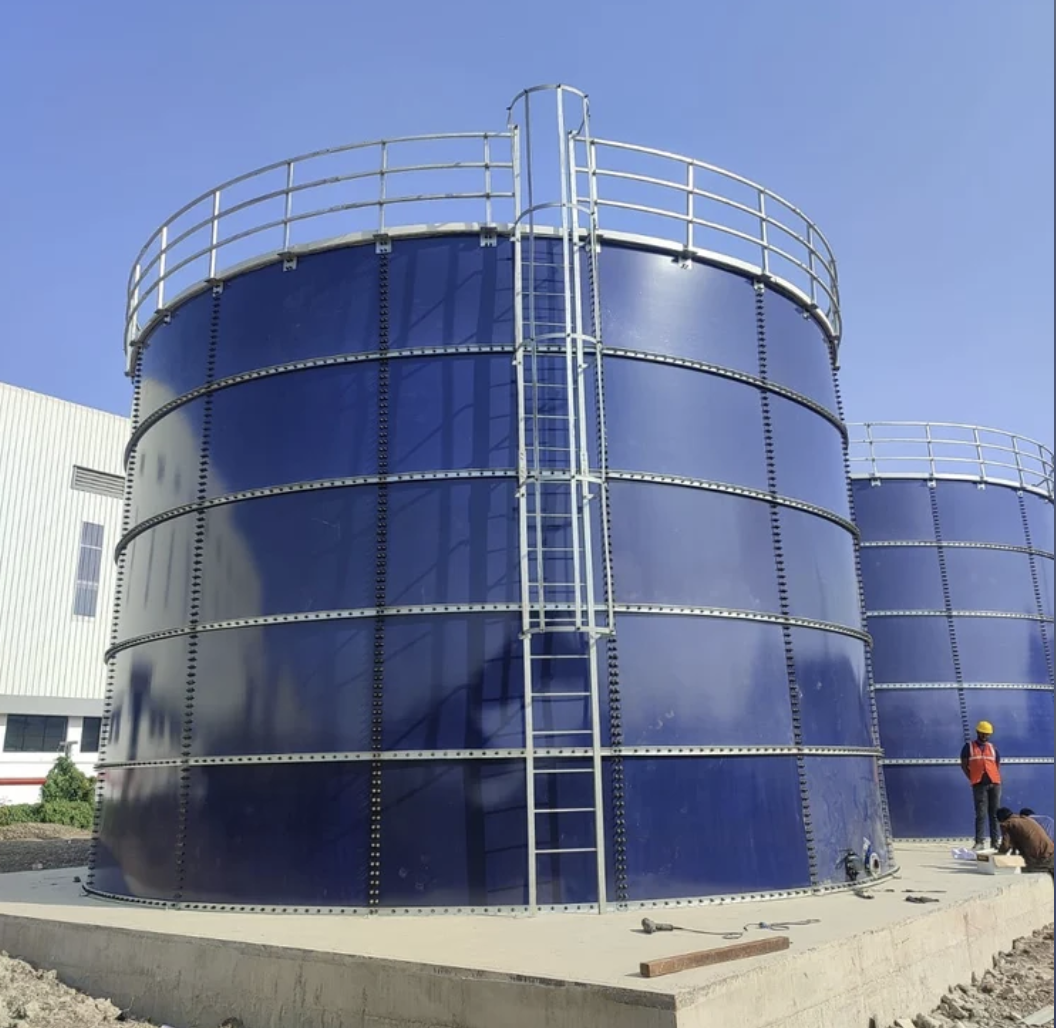
A growing number of Indian ETP operators are moving away from civil construction altogether for new tanks and replacement projects. Micro-coated bolted steel tanks have emerged as the proven permanent solution. They eliminate the four failure modes listed above because the construction logic is entirely different.
- The tank shell is steel — non-porous by nature. There is no matrix for effluent to migrate through.
- The contact surface is a thick micro-coated polymer system engineered for chemical inertness across the typical ETP pH range of 4 to 11.
- There is no rebar to corrode. The steel structure is on the outside of the lining, isolated from the effluent it contains.
- The tank is bolted from factory-prefabricated panels — joints are gasketed and engineered, not improvised on a wet construction site.
Why Micro Coating Works Where Other Coatings Fail
The micro-coated tank is not just steel painted with epoxy. It is a multi-layered engineered system: the steel substrate is shot-blasted to a controlled surface profile, a primer is applied, and then a thick polymeric coating is bonded under factory-controlled curing conditions. The coating thickness, adhesion strength and pinhole-free integrity are tested on every panel before it leaves the factory.
On site, the panels are bolted together and the seams are sealed with engineered gaskets — no welding, no concrete pour, no rebar, no curing time. The result is a tank that is operational in days rather than weeks, and that holds its integrity for decades because the materials and joinery are designed for the duty.
Lifecycle Cost: The Honest Comparison
Civil tanks usually look cheaper at the purchase stage — that is the marketing argument every contractor leads with. But the comparison over a 20-year plant life looks very different when you include realistic maintenance costs.
- Civil RCC tank: lower upfront cost, but typically Rs. 8 to 12 lakhs in waterproofing recurring spend over 20 years for a 100 KL tank, plus 3 to 5 production shutdowns of several days each.
- Micro-coated bolted tank: higher upfront cost, but typically Rs. 50,000 to 1 lakh of routine inspection-and-gasket maintenance over the same 20 years, with no shutdowns required.
- Net effect: micro-coated tanks reach lifecycle-cost parity with civil tanks within 4 to 6 years, and deliver substantial savings beyond that point.
When Replacement Is the Right Call
For operators of an existing ETP plant facing recurring leakage, the question is when to stop patching and start replacing. Our engineering team typically recommends replacement when any of the following is true:
- The tank has had two or more waterproofing applications in the last five years
- Visible cracking is present at construction joints or pipe penetrations
- Effluent quality testing shows seepage to the surrounding soil or groundwater
- Compliance penalties or expansion requirements make further patching impractical
- Plant downtime cost for the next waterproofing cycle exceeds the cost of replacement
How We Can Help
At SAGOSI we engineer and supply Micro-Coated bolted steel tanks designed specifically for effluent service — STP aeration tanks, ETP equalisation and reaction tanks, sludge holding, and treated effluent storage. Our engineering team can assess your existing civil tank condition, recommend whether replacement is cost-justified, and design the right replacement specification for your effluent chemistry.
If you are experiencing recurring leakage with your current ETP tank, the most useful first step is to share your tank capacity, effluent characteristics, and a brief history of the leakage issue. We will respond with an honest assessment and a tailored proposal. Use our enquiry form to start the conversation.